
Tuesday’s Election Could End Netanyahu’s Long Rule in Israel

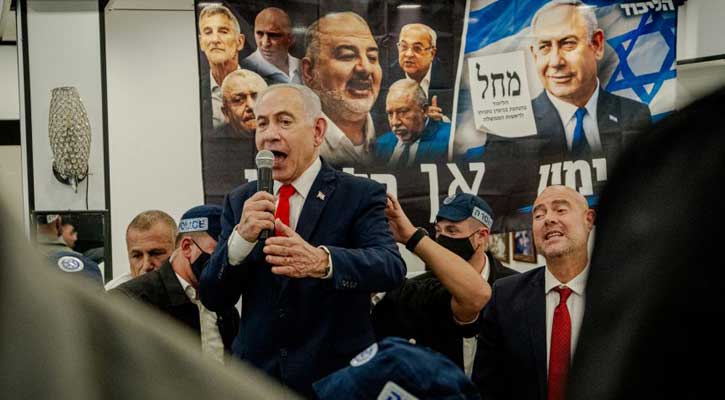
Israel will hold its 26th national election on Tuesday, October 27, in the first election since the Hamas-led attack on October 7, 2023. The vote could determine the political future of Prime Minister Benjamin Netanyahu, who has been a dominant figure in Israeli politics for years.
According to a Reuters report, Netanyahu faces a tough challenge from former military chief Gadi Eisenkot, former Prime Minister Naftali Bennett and other opposition leaders.
Based on polling data available through October 20, Reuters’ survey projections suggest that parties opposed to Netanyahu could collectively win around 62 of the Knesset’s 120 seats. A minimum of 61 seats is required to form a government. However, it remains uncertain whether the opposition can maintain a parliamentary majority after the election.
Eisenkot, a former chief of the Israeli military, has emerged as a major challenger to Netanyahu’s right-wing Likud Party. His centrist Yashar Party is presenting itself as an alternative to the current leadership. Eisenkot has highlighted his military experience and security credentials. The loss of his son in the Gaza war has also become a significant part of his political identity.
Meanwhile, former Prime Ministers Naftali Bennett and Yair Lapid have joined forces under the banner of “Together.” Both have previously played roles in efforts to keep Netanyahu out of power. Their goal this time is to secure enough parliamentary support to bring about a change of government.
Other prominent figures in the anti-Netanyahu camp include former Defence Minister Avigdor Lieberman and former general Yair Golan. However, ideological differences among opposition parties could make it difficult for them to agree on a governing coalition after the election.
Arab political parties may also play a decisive role. Arab citizens make up roughly one-fifth of Israel’s population. Parties representing them, including Ra’am and the Joint List, could influence coalition negotiations if neither political bloc secures a clear majority.
The October 7, 2023, Hamas-led attack and the subsequent security situation have become central issues in determining Netanyahu’s political future. The attack exposed major failures in Israel’s security system. The prolonged military campaign in Gaza, clashes in Lebanon and the broader conflict involving Iran have since had a profound impact on Israeli politics and society.
A survey by the Jerusalem-based Israel Democracy Institute found that around 68 percent of Jewish Israelis believe the October 7 attack and its aftermath will influence their voting decisions. Among Arab Israelis, 32 percent consider the issue important. Crime and law-and-order concerns in their local communities are also major issues for Arab voters.
Netanyahu’s supporters portray him as an experienced leader on security and military matters. His critics, however, question his government’s handling of security before and after the October 7 attack and have called for accountability.
The corruption cases against Netanyahu are another significant issue in the election. He is standing trial on charges including bribery, fraud and breach of trust. Netanyahu denies the allegations.
The election is also being closely watched internationally. Netanyahu’s policies on the Gaza war and his military strategy concerning Lebanon, Syria and Iran have influenced regional politics. International observers will be watching to see whether a new government maintains these policies or introduces changes.
Under Israel’s electoral system, a government needs the support of at least 61 members of the 120-seat Knesset. No single party has traditionally secured an outright parliamentary majority, making coalition governments the norm. A party must receive at least 3.25 percent of the valid vote to qualify for parliamentary representation.
Israeli voters cast ballots for party lists rather than directly electing a prime minister. After the election, the president assigns the task of forming a government to a candidate considered most likely to secure majority support in parliament. Therefore, winning the most seats does not automatically guarantee the right to govern.
Ultimately, Israel’s next prime minister will depend on which political camp can secure the backing of at least 61 lawmakers.